Wind Brake
During more than 15 years of reporting on the opposition to solar and wind projects, I’ve never seen anything like the opposition to the Lava Ridge wind project.
As I explained in these pages last September, the entire state of Idaho was against it.
In 2023, the Idaho House of Representatives unanimously passed a resolution stating its opposition to the proposed project, which aimed to put a 1,200-megawatt wind project on 57,000 acres of federal land near the southern Idaho town of Dietrich. Residents objected to the project for multiple reasons, including concerns that it would infringe on the Minidoka National Historic Site, which commemorates the incarceration of thousands of Japanese-American citizens during World War II.
Despite the state’s fierce opposition, the Biden administration predictably did Big Wind’s bidding. On December 11, 2024, less than six weeks before Joe Biden left the White House, the Department of Interior published a short note in the Federal Register saying that it would issue a permit for New York-based LS Power to build the 231-turbine project on acreage owned by the Bureau of Land Management.
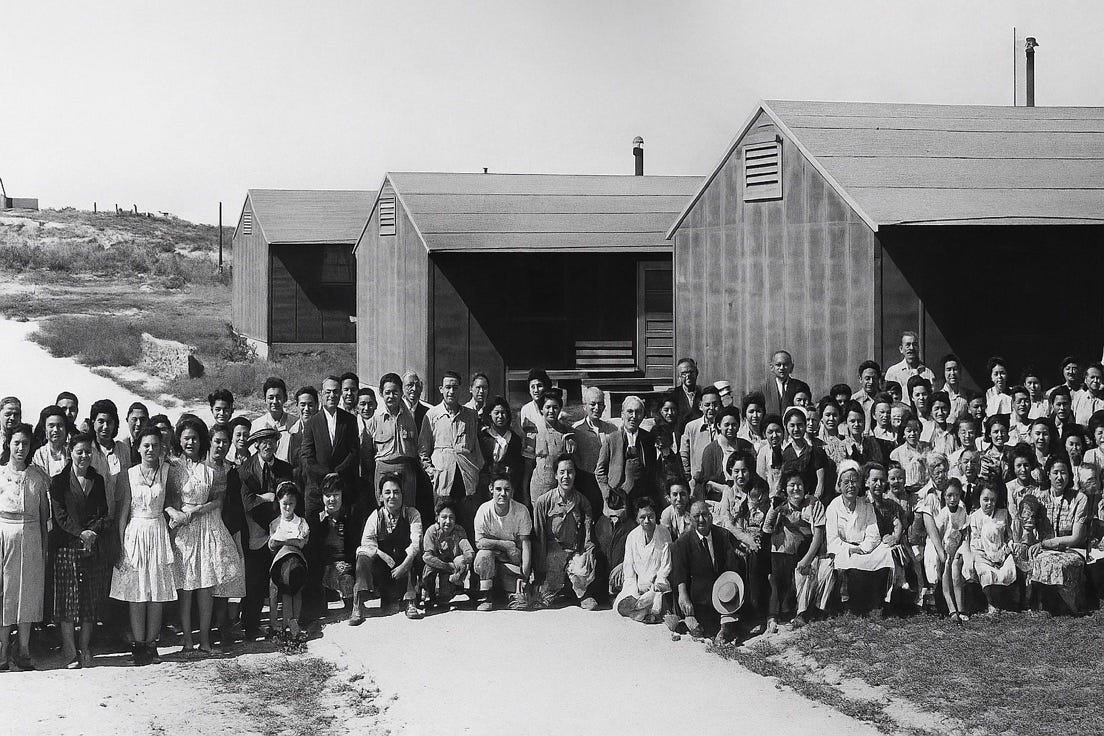
Japanese-American internees at the Minidoka War Relocation Center, in an undated photo. Photo credit: Wikimedia, enhanced by ChatGPT.

The wind industry’s deadly impact on birds is well known. I have been reporting on the Migratory Bird Treaty Act and Bald and Golden Eagle Protection Act for more than 30 years. For decades, the wind industry has largely been exempted from the enforcement of those statutes.
No longer.
On his first day in office, President Trump signed an executive order that directed all federal agencies to immediately assess “the environmental impact of onshore and offshore wind projects upon wildlife, including, but not limited to, birds and marine mammals.” On August 4, Burgum published a note on X, saying his agency will be “enforcing the Bald and Golden Eagle Protection Act to ensure that our national bird is not sacrificed for unreliable wind facilities!” In the same post, a top official at Interior said the Fish and Wildlife Service (FWS) would “complete a review of permit applications for wind energy projects to determine whether” they are complying with the provisions of the Bald and Golden Eagle Protection Act.
That looming change in federal wildlife law enforcement matters because if Anschutz succeeds in getting the Chokecherry project built, it will be the largest wind project in North America. It will also be deadly for eagles.
In 2017, the BLM released an environmental assessment of the project, which estimated that during the first phase of the wind project, it would kill as many as 14 Golden Eagles and two Bald Eagles every year, along with thousands of bats, hundreds of raptors, and about 5,400 non-raptor birds.
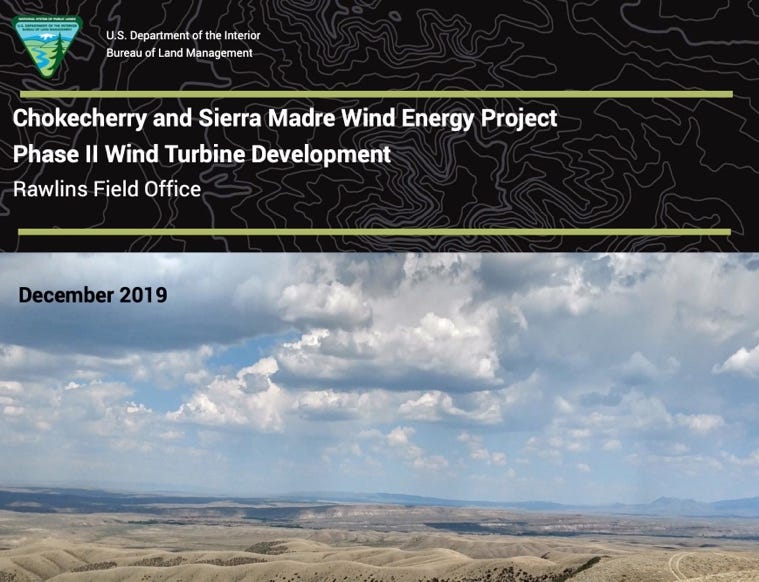
Title page of the BLM assessment of Anschutz’s proposed wind project, which found it could kill up to 64 Golden Eagles per year. Credit: BLM.
Another BLM assessment, published in December 2019, came up with even larger numbers. It estimated that the Chokecherry project could “result in annual mortalities of 6,300 bats, 150 to 210 raptors, 46 to 64 Golden Eagles, and 5,400 non-raptors.”
The scale of Anschutz’s proposed project boggles the imagination. The $5 billion, 3.5 gigawatt project — owned by his Power Company of Wyoming — could cover nearly 220,000 acres near Rawlins (much of that property owned by the BLM) with 600 massive wind turbines. For perspective, the project will cover about 344 square miles, an area 15 times larger than the island of Manhattan.
The Chokecherry project has been in the works since 2012, when the Obama administration announced its intention to approve it. But construction has been delayed several times. Last October, Power Company of Wyoming got a second extension of the building permit for the project from the Carbon County Commission. The company now says it may finish it in 2029.
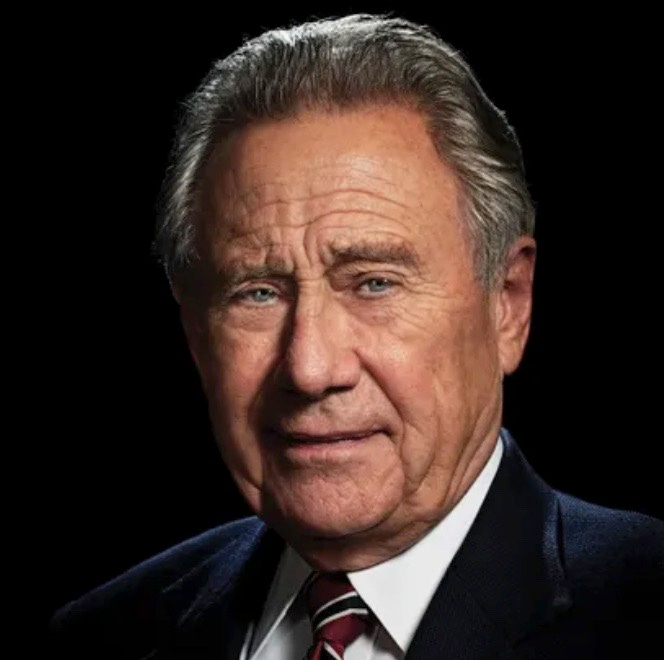
Philip Anschutz. Photo credit: Forbes.
According to Forbes, Anschutz, 85, is the 144th richest person on the planet with a net worth of $16.9 billion. He made his money in oil and gas, railroads, and entertainment. He has used part of his vast fortune to buy influence in Washington. He nearly got a provision inserted into the final version of the One Big Beautiful Bill Act that would have assured him hundreds of millions of dollars’ worth of tax credits per year for the Chokecherry project. That narrowly written 65-word provision was deleted before the OBBBA became law. According to Open Secrets, during the last election cycle, Anschutz gave money to dozens of politicians, all of them Republicans. He also gave more than $100,000 to the National Republican Senatorial Committee and more than $100,000 to the National Republican Congressional Committee. In all, he has given at least $400,000 to Republican politicians or causes since January 2023.
In addition to Anschutz’s project, federal authorities should also be scrutinizing two other proposed wind projects in Wyoming: the Rail Tie wind project, which is owned by the Spanish oil giant, Repsol, and Two Rivers, a 280-MW wind project which is being promoted by Canada’s BluEarth Renewables and Clearway Energy, which is owned by French oil company TotalEnergies and Global Infrastructure Partners, which is owned by financial giant BlackRock, which manages $11.6 trillion in assets.
Speaking of Two Rivers, on December 19, 2024, the Biden administration again did the bidding of Big Wind. On that date, less than five weeks before Joe Biden left the White House, the BLM approved the Two Rivers project, which aims to put more than three dozen turbines on land near Medicine Bow in Carbon and Albany counties. The BLM’s environmental assessment found the proposed project will have “30 turbines located less than two miles from recently documented Golden Eagle nests, two of which are less than one mile from a golden eagle nest,” and that the project will likely kill three Golden Eagles per year. And yet, Biden’s appointees still approved the project.
The danger these massive wind projects pose to Golden Eagles has been known for a decade.
In 2016, the American Bird Conservancy — one of the few (only?) NGOs in America that’s genuinely interested in protecting wildlife — identified “10 of the worst sited wind energy projects for birds in the US.” It included Anschutz’s Chokecherry project “because of its potential impacts on Greater Sage-Grouse and Golden Eagles.” It continued, saying that the Wyoming location is “not a good place to put large-scale commercial wind energy and associated infrastructure from the perspective of wildlife conservation.” A year earlier, ABC noted that the FWS itself had determined that “Golden Eagle populations in the United States may not be able to sustain any additional, unmitigated mortality and the threshold for this species is zero.”
Why should you care? Golden Eagles are far rarer than Bald Eagles.
According to the FWS, there are only about 32,000 Golden Eagles in the western US. By contrast, the agency estimates the Bald Eagle population in the Lower 48 states is 10 times larger, with about 317,000 individuals.
Last December, the Albany County Conservancy, headed by a fourth-generation Wyomingite, Anne Brande, filed a federal lawsuit alleging that the Western Area Power Administration, which is part of the Department of Energy, violated federal law by ignoring the impacts that Repsol’s 500-MW project, which aims to put 149 turbines near Laramie, would have on wildlife, wetlands, and cultural resources in the region. In February, the Albany County Conservancy sent a letter to Burgum, Energy Secretary Chris Wright, and Attorney General Pam Bondi, requesting a halt to all federal permitting activities on the Rail Tie project.
A few months ago, I talked to Bill Eubanks, a Washington-based lawyer who represents the Albany County Conservancy in its litigation against the Rail Tie project. He told me that Wyoming is a “crucial place for the western breeding population of Golden Eagles. It’s important to their long-term viability. And we don’t know what will happen if we put all of these massive turbines in the middle of their habitat.”
Eubanks is an experienced litigator on federal wildlife issues. But on that point, he’s wrong. We know exactly what will happen if Anschutz, Repsol, and BlackRock are allowed to put close to 1,000 wind turbines in the middle of prime Golden Eagle habitat. The BLM’s own documents say dozens of the iconic raptors and thousands of other animals will be slain every year by those massive machines.
It's time to stop the crony capitalism that has been allowing Big Solar and Big Wind to use our federal lands without any concern for our wildlife. If the Trump Administration is serious about protecting our birds, bats, and other wildlife from the ongoing slaughter by Big Wind, it should immediately cancel the permits for Anschutz’s Wyoming wind project. It should do the same on Rail Tie, Two Rivers, and every other wind project hoping to put giant turbines on our federal land or in our federal waters.

Comments
Post a Comment