Shocking Betrayal: Why Progressives are Ditching Climate Laws and Dooming the Planet
This week, we released a bombshell new report detailing the massive costs and reliability challenges posed by New York State’s climate and energy policies.
Just kidding, the report, entitled New York’s Climate Crossroads: Assuring Affordable Energy, was actually a scathing piece from the Progressive Policy Institute (PPI)—but based on the findings, you would be forgiven for thinking we had written it.
PPI identified “a clear and undeniable pattern of failure” when assessing New York’s progress in meeting the mandates in its signature climate law, the 2019 Climate Leadership and Community Protection Act (CLCA).
According to the New York Post, Neel Brown, the author of the PPI study, said:
“New York set bold climate targets, but ignored the economic and technical realities required to achieve them.”
We couldn’t have said it any better ourselves.
Failure to Launch
PPI reports that the key mandates in the CLCA are:
· Greenhouse Gas Reductions: 40 percent reduction from 1990 levels by 2030 and 85 percent by 2050.
· Zero-Emission Electricity: 100 percent zero-emission electricity by 2040.
· Renewable Energy Grid: 70 percent of electricity from renewable sources by 2030.
· Offshore Wind: Install 9,000 megawatts (MW) by 2035.
· Distributed Solar: Install 10,000 MW by 2030.
· Energy Storage: Install 6,000 MW by 2030.
·
Hilariously, and unsurprisingly, the PPI study found New York is nowhere near meeting any of these goals, except rooftop solar. But as we noted in our piece Stealing with Solar, net metering raises prices for everyone by shifting the costs of maintaining the grid to the people who can’t afford rooftop solar installations.
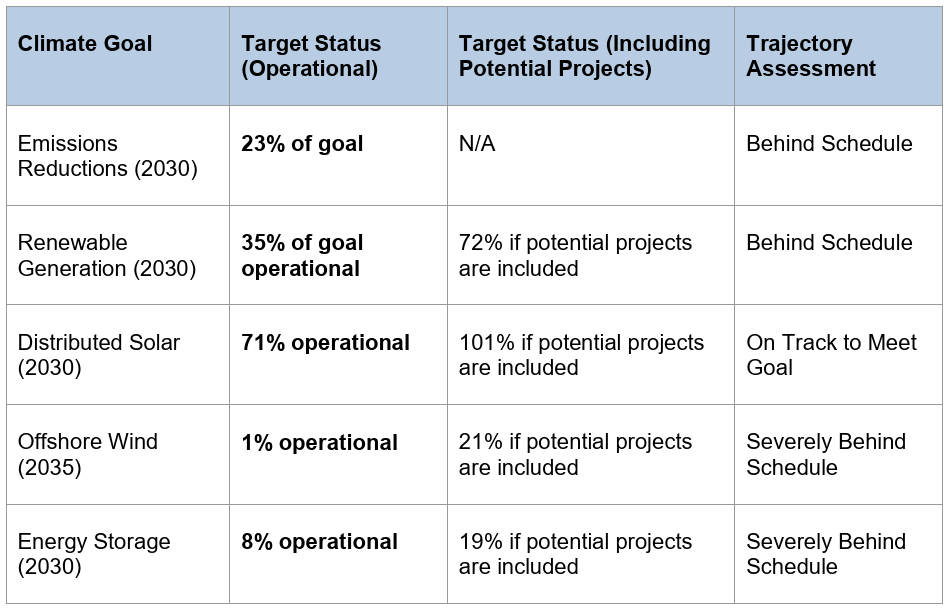
And these findings aren’t surprising, because the fact is that these weren’t realistic goals to begin with.
While 10 to 30 years may seem like a long time for us, this is a relatively short period in terms of the electricity grid, where traditional power plants like coal, natural gas, oil, and nuclear can keep churning out affordable and reliable power for 60+ years. This is especially true when you’re discussing radically altering the resource mix of the grid, which is what New York and other state policies are seeking to accomplish.
Achieving these policy goals was doomed to fail from the beginning.
THE LOOMING CRISIS: A COLLISION OF SUPPLY, DEMAND, AND COST
Amazingly, that was the actual headline in the PPI report, as they note:
New York’s energy system is entering an environment where policy-driven pressures are converging to make the 2019 climate goals increasingly untenable. A combination of shrinking reliable energy supply, inflated demand growth, and mounting cost pressures is creating a collision course that threatens both grid stability and consumer affordability.
“This collision is not accidental; it is the direct result of a policy framework that simultaneously dismantles reliable supply while mandating a surge in demand, with ratepayers bearing the inevitable and escalating cost.
This is a common trend across the entire country and something we have noted frequently. It’s a simple formula that is easy enough to understand:
Reducing Firm Capacity + Mandating Load Growth + Massive Spending on Climate Policies = Low Supply and High Costs.
This is why despite having the most power capacity on the grid than ever before, energy supply constraints are major issues across America, because the only net capacity additions on the grid for over a decade have been intermittent wind and solar resources, whereas firm capacity (mostly coal, natural gas, and coal) peaked in 2011 and has been in a steady decline ever since. In fact, firm capacity on the grid in 2024 was back at 2004 levels when electricity demand was over 330 million megawatt-hours less.
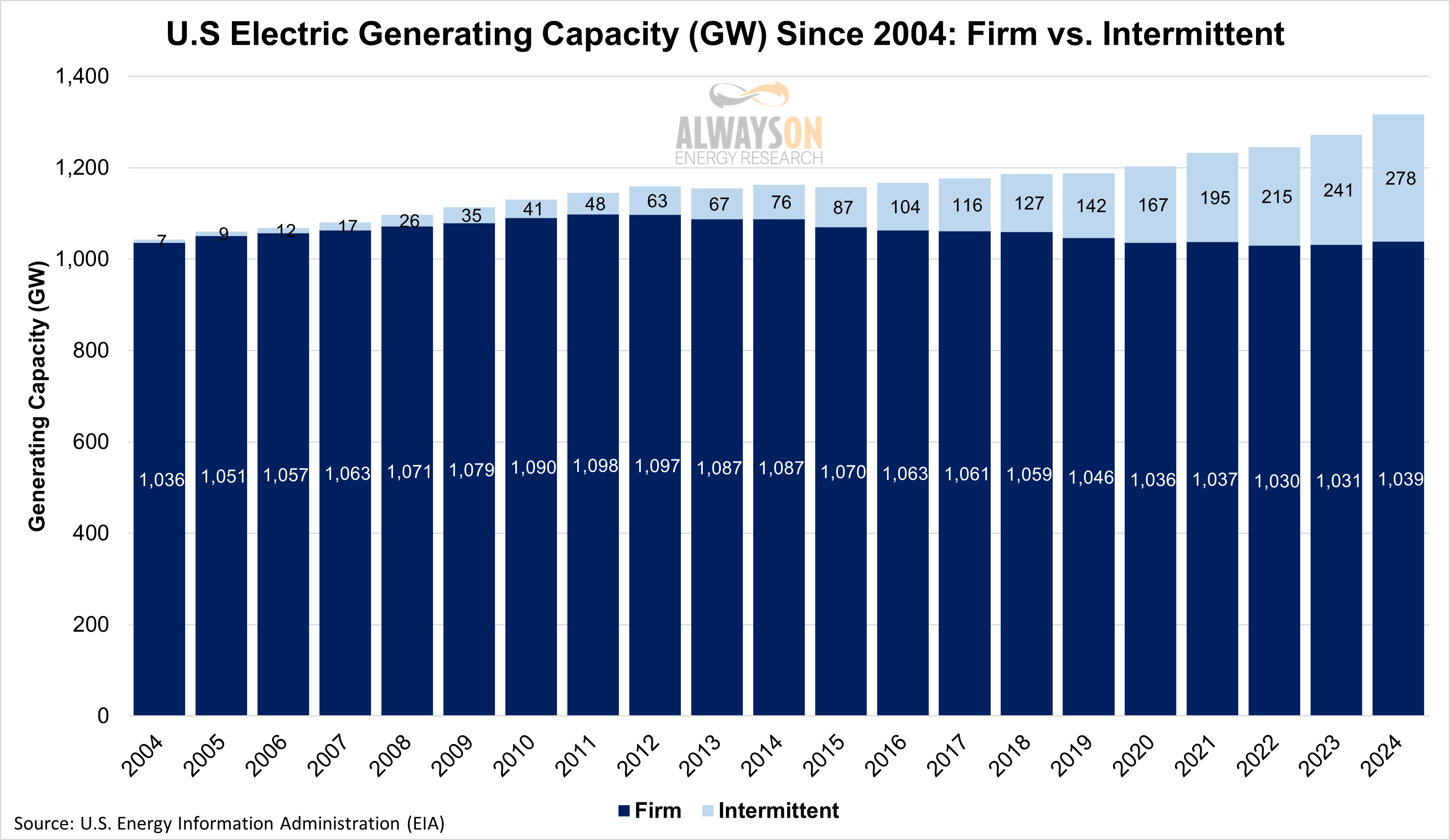
This graph shows total U.S. capacity on the system since 2004, differentiating between firm/traditional capacity (coal, natural gas, nuclear, hydro, other) and intermittent capacity (wind and solar).
Constrained Supply
The same is true for New York, as PPI notes:
While the state mandates a massive buildout of renewable energy, its existing firm generation capacity is being actively diminished. In 2024, natural gas (62 TWh) and nuclear (27 TWh) still provided the vast majority of the state’s firm, dispatchable power, highlighting the monumental scale of the replacement challenge.
PPI also noted that the premature closure of the Indian Point nuclear plants in 2021 removed a significant source of carbon-free power from the grid, making it harder to achieve the state’s emissions goals. We would also add that it made it harder to keep the lights on, as the New York Independent System Operator (NYISO) warns that the state could see an increased risk of power shortages as soon as next year.
Natural gas also played a starring role in the report, as PPI notes:
Blocked Infrastructure Upgrades: The New York Department of Environmental Conservation has blocked a number of upgrades to aging natural gas generation facilities. Policymakers have also prevented the construction of new pipeline capacity, limiting the efficiency and availability of a critical fuel. However, a recent (Nov 2025) state reversal has given approval to a new natural gas pipeline into New York City.
PPI should have added banning hydraulic fracturing in the Marcellus shale for pseudoscientific reasons in Upstate New York to this list as another reason for constrained fuel supplies, but you can’t win ‘em all.
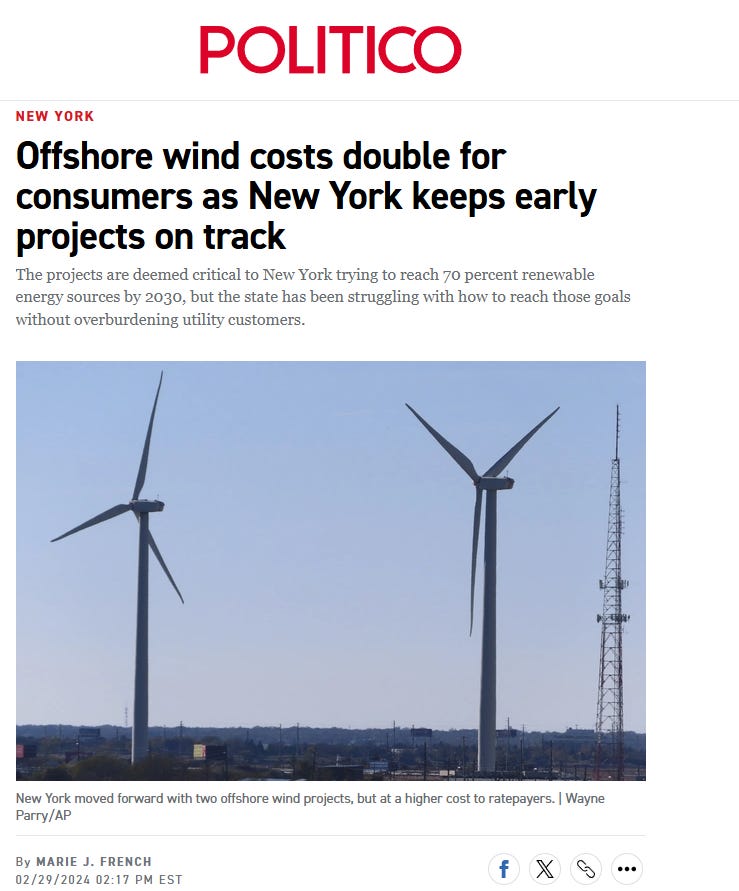
Lastly, PPI blames the Trump administration for erecting “External Barriers” to planned renewable energy projects. It’s true that Trump has given wind and solar a taste of the stick, but offshore wind was not exactly going swimmingly before Trump resumed office in January of 2025.
Electrocute Everything
At the same time New York has constrained the supply of nuclear and natural gas plants in the state, the state has simultaneously mandated a massive increase in demand by requiring the electrification of home heating and transportation. As explained by PPI:
Simultaneously, state policies are driving a projected surge in electricity demand, placing further strain on an already constrained supply. This growth is not organic but is a direct result of mandates aimed at electrifying other sectors of the economy.
PPI notes that the major drivers include electrification efforts for buildings and transportation, as well as for expected high-tech manufacturing and data centers.
The capacity buildout to meet new projected winter peak demands and the massive new spending on distribution infrastructure upgrades will ultimately be borne by the ratepayers in the form of higher costs.
A previous EBB post from November 22 showed this in action. Consolidated Edison Company in New York, which was one of the top companies seeking the largest rate increases on its customers, explicitly noted that most of the investments it is making is to facilitate wind and solar and load growth expectations stemming from the state’s electrification policies.
[T]he Core investments described in the Company’s Electric Infrastructure and Operations Panel (“EIOP”) direct testimony either facilitate interconnection of future renewable generation supply into the Company’s service territory or provide additional electric system capacity to accommodate increased load due to electrification of transportation and buildings.
Skyrocketing Costs
PPI found New York has experienced some of the fastest increases in electricity prices in the country. Retail electricity prices for residential customers increased by 36 percent between 2019 and 2024, nearly three times faster than the national average and the second-fastest increase in the country during this period, after California.
PPI’s analysis is weak on causality for these rising prices, stating:
Price rises have been driven by a range of factors, including the need to replace and upgrade ageing wires, poles, and towers in the distribution and transmission systems, as well as increased fuel costs and other operating costs. Major utilities in the state have filed rate cases requesting further increases of around 20%, citing the need to repair storm damage and upgrade distribution systems, as well as cover increases in taxes and operating expenses, which is likely to ensure rates increase further in 2025 and 2026.
A more robust analysis would have examined the impact of rooftop solar, renewable energy certificates, zero-emissions certificates, and New York’s membership in the Regional Greenhouse Gas Initiative.
The Existential Threat of Political Climate Change
And now we come to the real reason the report was probably written, the existential threat of political climate change. According to the New York Post, Brown warns that New York’s expensive and unreliable policies will become a political liability:
“The result is an energy system that is less reliable, more expensive, and now politically unsustainable [emphasis added]. Unless policymakers course correct, the state risks turning a climate leadership story into a cautionary tale.”
This sentence says the quiet part out loud.
It’s apparently perfectly acceptable for progressives to enact climate policies that undermine the reliability of the grid and make electricity unaffordable, as long as doing so is politically advantageous and allows them to claim the moral high ground of “following the science” and “acting on climate.”
However, claims that wind and solar will bring down costs are being obliterated by reality, and the public is growing increasingly unhappy about their rising electricity bills (even if they can’t always pinpoint the exact cause).
PPI writes that this anger threatens to undermine support for climate policy:
Prioritize Affordability to Sustain Public Support: The state must adopt a path that explicitly prioritizes both emissions reduction and affordability to achieve sustainable climate gains while easing the financial burden on working families. Policies that threaten to dramatically increase utility bills risk undermining public support for the entire climate agenda.
These alternative considerations lead to a fundamental conclusion about the political sustainability of New York’s current climate strategy. An approach that fails to balance ambition with practicality is destined to fail.
We have seen for some time that there doesn’t seem to be a path that can prioritize both emissions reductions and affordability without severely hampering reliability, relying on neighboring states/regions for energy when wind and solar generation fall to zero, or calling on customers to reduce demand to keep the grid from failing.
Conclusion
The states that rushed to pass unaffordable, unreliable, and unworkable climate mandates from 2017 to 2023 are the dogs that finally caught the car. They signaled their virtue by passing the legislation, but now their citizens are living with the consequences of skyrocketing costs.
New York’s climate policies were always going to cause prices to skyrocket, threaten system reliability, and, in the end, probably fall short of their emissions mandates.
Now liberal New York politicians are seemingly worried about the growing crisis of political climate change, and they should be.

Comments
Post a Comment