Climate Change is Making Us Stupid
I take the title of today’s post from the closing line of a fantastic 2014 article by Dan Sarewitz in Slate. Sarewitz wrote:
“Climate change, added on top of all the other causes of these problems, will often make things worse. But for the most part there will be no way to tell which ones are worse than they would have been anyway, or how much worse they have become. So it’s not that apocalyptic fears about climate change are utterly fantastic—climate change may well exacerbate a range of serious and potentially even disastrous problems—it’s that the monomaniacal, apocalyptic version of climate change gives us a picture of the world that is so incomplete that it’s much worse than simply wrong. Worse because, just like religious and political orthodoxy, it cannot be falsified. On the contrary, everything that goes wrong simply reinforces the conviction that there is just one explanation for all our problems—climate change—and that there is only one thing we can do to keep the world from collapsing—stop burning fossil fuels. And thus, worse because the climate-change-as-apocalypse orthodoxy thereby radically narrows the range of viewpoints we are willing to tolerate and the range of options we are willing to consider for dealing with complex challenges to our well-being like natural disasters and infectious disease and poverty and civil strife.”
The notion of climate change has collapsed our discussions of complex environmental-social-political issues into a cartoonish characterization of “climate change” as an all-purpose causal agent responsible for just about everything that people don’t like — Wildfires? Climate change. Immigration? Climate change. Jellyfish? Climate change.
The climate does change and humans influence the climate. Neither Sarewitz nor I here at THB challenge these basic realities — they are not the problem.
Back to Sarewitz on what is the problem:
“The real problem is . . . the hysterics . . . who insist, often in the name of science, that all the suffering to come will have only one true cause, and that redemption can be achieved only by following one true path. No matter that long and sad human experience teaches us where such absolute orthodoxies lead. Indeed, with climate change being blamed for almost everything these days, the one phenomenon that seems to have escaped the notice of scientists, environmentalists and the media alike is that, perhaps above all, climate change is making us stupid.”
One constant over my career — dating to my postdoc at NCAR in the mid-1990s — has been a focus on extreme weather and its impacts. Over the decades, when it comes to extreme weather, I have observed the dynamics described by Sarewitz move from advocacy into journalism and eventually into climate research itself.
How we talk, and apparently think, about climate change has become stupider.
Let me illustrate with an example.
You may recognize the graph below which from its formatting looks like it comes from the new THB Global Extreme Weather and Climate Change Dashboard. I’ve blacked out the variable name to just focus on the data for a moment.
|
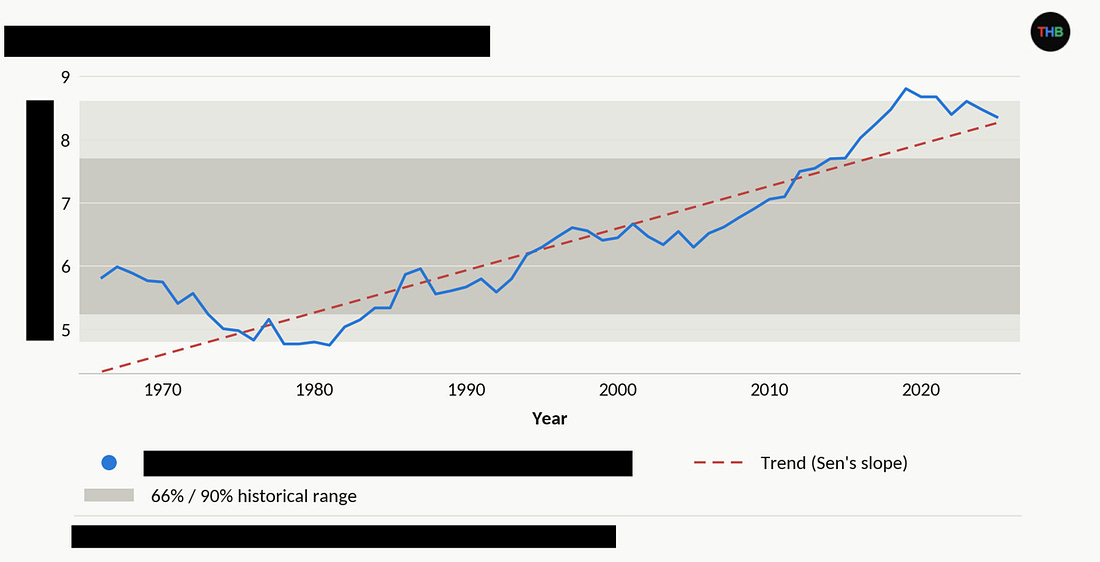
The time series dates to the 1960s and you don’t have to be a statistician to see that the variable has an increasing trend. That trend meets the criteria for a “detected change” without establishing causality according to the standards of detection of the Intergovernmental Panel on Climate Change (IPCC).
With such a trend in a climate variable, it is common to see explanations like the following from authoritative sources (emphases added):
- European Commission: “Floods are the most common and most costly natural disasters in Europe. They are becoming more frequent due to climate change. . . ”
- Nature: “The frequency of the most persistent heatwaves is increasing rapidly because of climate change.”
- Canadian government: “Climate change is making natural disasters more severe, more frequent, more damaging and more expensive.”
- npj Natural Hazards: “Floods are intensifying globally, primarily due to climate change.”
Such assertions are ubiquitous and banal.
In fact, it has become so common to associate any trend (or event) with “climate change” that we seem to have lost the ability to see just how dumb our discourse has become.
Let me try to escape the banality.
The figure above is not a climate time series and it does not come from the new THB Global Dashboard.
It is actually a baseball time series — showing strikeouts per team per game over the 1966-2025 MLB seasons. There are more strikeouts per game now than in earlier decades.
|
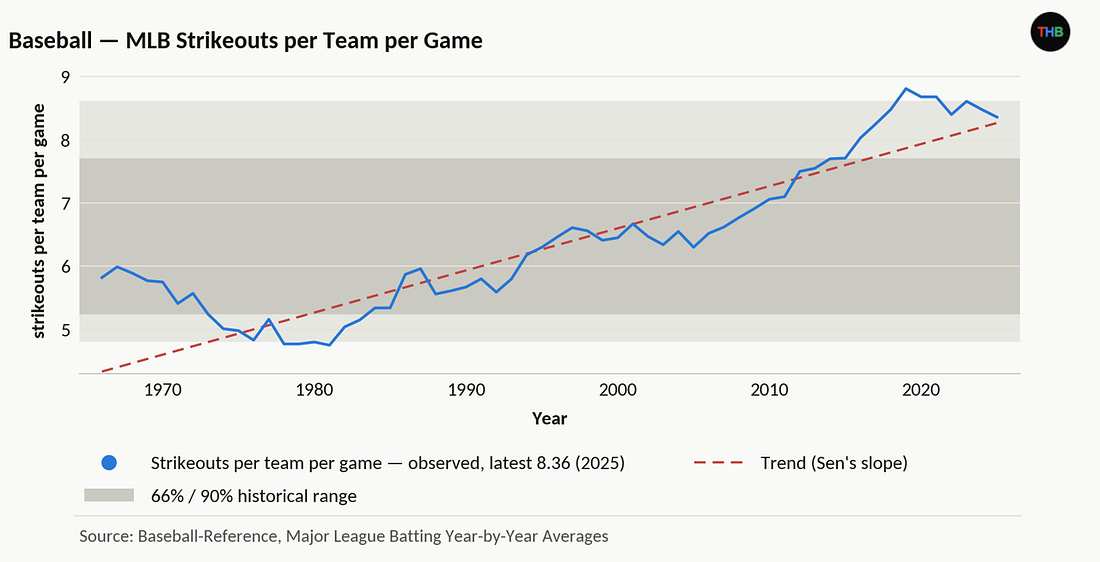
Let’s call this detected change Baseball Change to refer to a change in a statistic of the game of baseball that occurs over decades and is larger than the variation we’d expect season-to-season.
Let’s revisit those four climate change quotes above and reinterpret them in the context of strikeouts and baseball change:
- “Strikeouts are a common and defining feature of baseball. They are becoming more frequent due to baseball change . . . ”
- “The frequency of strikeout streaks per game is increasing rapidly because of baseball change.”
- “Baseball change is making strikeouts more frequent, with more contactless swings, and more long walks back to the dugout.”
- “Strikeouts are intensifying across the MLB, primarily due to baseball change.”
If you or I heard anyone talk like this we’d think that they might have a screw loose, because these sentences don’t actually mean anything.
Strikeouts per game have changed for lots of reasons — height of the pitching mound, designated hitter rules, changing definition of the strike zone, umpire grading, use of the bullpen, pitching, grip and spin, hitting, expansion of the league, and more — it is much more complicated and interesting than baseball change!
I started conceptualizing this post after I noticed that the recent NASEM report on the Attribution of Extreme Weather and Climate Events and Their Impacts (July 2026) did not define climate change anywhere in the report.
However, throughout, the NASEM report characterizes climate change as a causal agent (emphases added):
- “Climate change increased the intensity of the rainfall” (flooding in Germany 2021, p. 37);
- “Climate change caused snowfall to increase in northern Spain... but decrease in southern Spain” (Storm Filomena, 2021, p. 105);
- “Increased rainfall due to climate change caused a 5–19% increase in flood volume” (Cyclone Idai, Mozambique, p. 107);
- “Climate change led to an increase in the maximum wind speeds by approximately 7 percent” (Hurricane Melissa, p. 108).
Given that the IPCC has not claimed to have achieved detection for flooding, snowfall, or tropical cyclone maximum wind speeds, I found it odd that “climate change” was claimed to have such a large causal effect on these individual events, given also that the IPCC definition of “climate change” does not characterize it as a causal agent.
I felt like I was reading about baseball change being the cause of not just more strikeouts over decades, but why Abimelec Ortiz struck out on a 1-2 slider in the first inning last night, the pitch that made Jacob deGrom the second-fastest pitcher ever to 2,000 strikeouts.
Imagine the headline: Baseball change caused Ortiz to swing and miss last night.
Puzzled and curious, I emailed the chair of the NASEM committee, Jim Hurrell at Colorado State University, whom I know a bit from our overlapping years at NCAR in the 1990s and early 2000s, and I asked him the following questions about the report, which I share here for completeness:
I have a few questions about how the [NASEM] report uses the term “climate change,” and I’d value your view.
I note that the report does not define “climate change” (it does define 23 other terms) — yet throughout the report “climate change” is invoked as a causal agent that influences weather. This is contrary to the IPCC usage, which defines “climate change” as
“A change in the state of the climate that can be identified (e.g., by using statistical tests) by changes in the mean and/or the variability of its properties and that persists for an extended period, typically decades or longer. Climate change may be due to natural internal processes or external forcings such as modulations of the solar cycles, volcanic eruptions and persistent anthropogenic changes in the composition of the atmosphere or in land use.”
For the IPCC, “climate change” is not a causal agent, but the outcome of causes.
The report does define causal factors much as the IPCC does:
“Influences on the climate system, including both external forcings—which may be either anthropogenic (greenhouse gases, aerosols, ozone precursors, land/water use) or natural (volcanic eruptions, solar cycle modulations)—and slowly varying components of the system (sea-surface temperatures, sea ice, soil moisture, snow cover) that are known to influence climatic conditions on seasonal timescales.”
Yet, neither the report, nor the EEA [Extreme Event Attribution] literature, attempts to disaggregate attribution in the context of this complexity. For instance, WWA-style [World Weather Attribution] methods assign the full difference between factual and counterfactual worlds to “climate change” without partitioning attribution among the causal factors the glossary distinguishes.
The report is also explicit that it
“focused primarily on greenhouse gas emissions and industrial and biomass burning aerosols as the dominant factors in current anthropogenic climate change, while acknowledging that other human-driven influences play a role and can also be considered when studying the full scope of human impact on the climate. These other factors include non–greenhouse gas pollutants and changes in land use such as deforestation, urbanization, agriculture, and water use and diversion, among others.”
The report also notes, “the committee focused on the overall accumulation of greenhouse gases from human activities…”. The narrow focus on GHGs (or just CO2) becomes problematic in situations like European heat wave trends where aerosol changes are hypothesized to be as or more important than GHG forcing.
The report does not discuss individual GHGs (e.g., methane appears just once, SO2, N2O do not appear).
So my questions:
- Does the report implicitly use “climate change” as synonymous with “greenhouse gas emissions and industrial and biomass burning aerosols”?
- Or is “climate change” simply synonymous with fossil fuel-related greenhouse gas emissions, as the Chapter 2 discussion of the Vermont Superfund Act might imply?
- Or, a third option, is “climate change” supposed to reflect all of the causal factors (as defined in the glossary and reproduced above, consistent with IPCC) in one big bucket with no disaggregation?
- Or is there another implied definition other than these possibilities? Multiple meanings across chapters?
Let me know what you think. Many thanks from Boulder,
Jim quickly and graciously responded to my email, shared in full below (emphases added):
Thanks for your thoughtful note.
The committee did not intend “climate change” to be synonymous with any particular forcing, nor specifically with fossil-fuel CO₂ emissions. Throughout the report, the term is used to refer to the anthropogenically altered climate state that is compared with a counterfactual climate state in attribution studies.
Importantly, the anthropogenic perturbation represented in that comparison depends on the design of the attribution study. Some attribution studies evaluate the combined effect of anthropogenic forcings, while others are designed to isolate the influence of particular forcings or processes. The report therefore does not assume a single universal definition beyond the experimental framing of a given attribution analysis.
The report explicitly recognizes that anthropogenic forcings such as aerosols and land-use change can be important —particularly at regional scales — and identifies improved quantification of their individual contributions in event attribution studies as an important research priority (Conclusion 4.9).
I appreciate Jim’s straightforward reply, and the NASEM committee deserves credit for openly acknowledging a significant shortfall in extreme event attribution methods.
But take a moment to see what has happened here: Climate change, as explained by Hurrell, is not a statistical measure of how the climate has changed — as it is under the IPCC. It means a difference between an imaginary modeled world (what Hurrell calls the “counterfactual climate state”) and either some local observations or another modeled world standing in for the world we live in.
The difference between the imaginary world and the supposed real world is “climate change” which is not just a descriptor of the difference, but also an integrated, all-cause explanation for why those differences exist.
The NASEM report shrinks that all-cause explanation narrowly significantly when it explains that it primarily equates “climate change” with the consequences of greenhouse gas emissions and industrial aerosols, even while acknowledging that there are other factors that influence climate (p. 22):
The committee focused primarily on greenhouse gas emissions and industrial and biomass burning aerosols as the dominant factors in current anthropogenic climate change, while acknowledging that other human-driven influences play a role. . . These other factors include non–greenhouse gas pollutants and changes in land use such as deforestation, urbanization, agriculture, and water use and diversion, among others.
The NASEM report also observes that the literature it is surveying does not actually do any sort of attribution as defined by the IPCC (p. 126):
Very few event attribution studies consider the role of non-greenhouse-gas forcings such as aerosols, irrigation, and land-surface changes, despite their substantial influence on historical climate trends in several vulnerable regions... Isolating the role of multiple anthropogenic forcings is important for identifying the physical drivers of events, attributing event characteristics to regionally relevant forcings, and accurately assessing the magnitude of influence of greenhouse gases . . .
The NASEM has defined “climate change” in a way that makes detection (a la IPCC) unnecessary and attribution (a la IPCC) assumed away.
If “climate change” is defined study-by-study — as Hurrell explained in his email — then claims that “climate change” increased Germany’s flood or Hurricane Melissa’s winds are impossible to interpret — other than as an ink blot.
Like Sarewitz said, “climate change” is making us stupid.
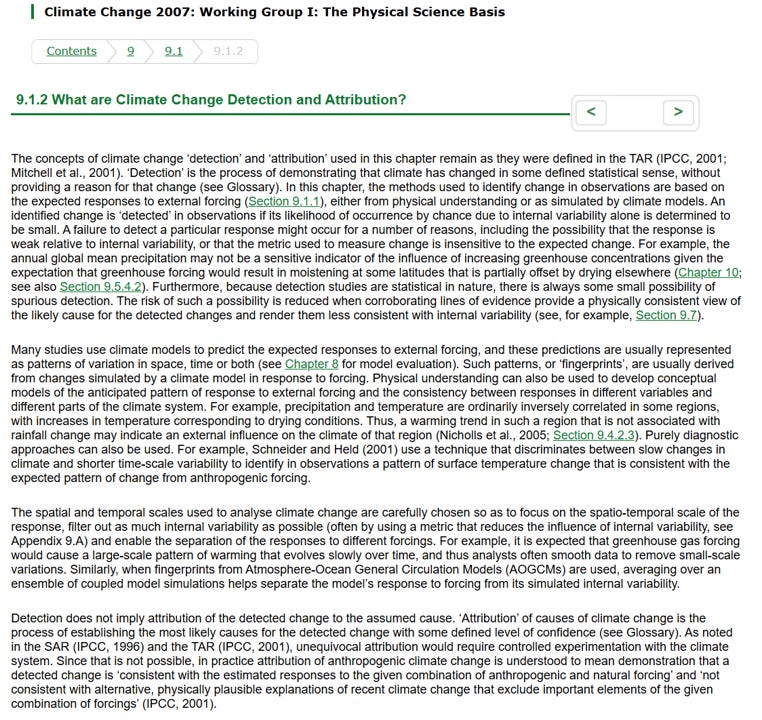
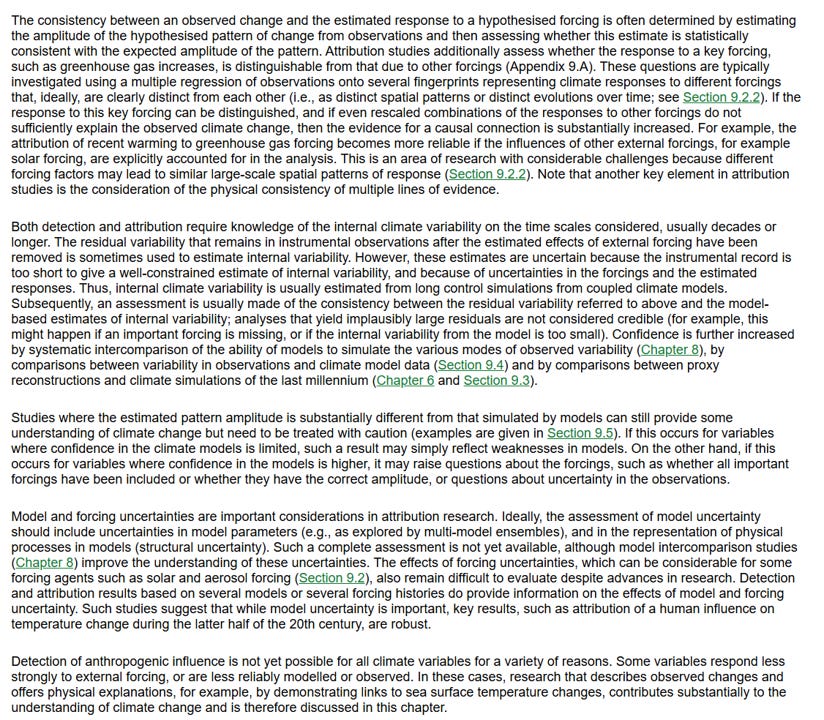
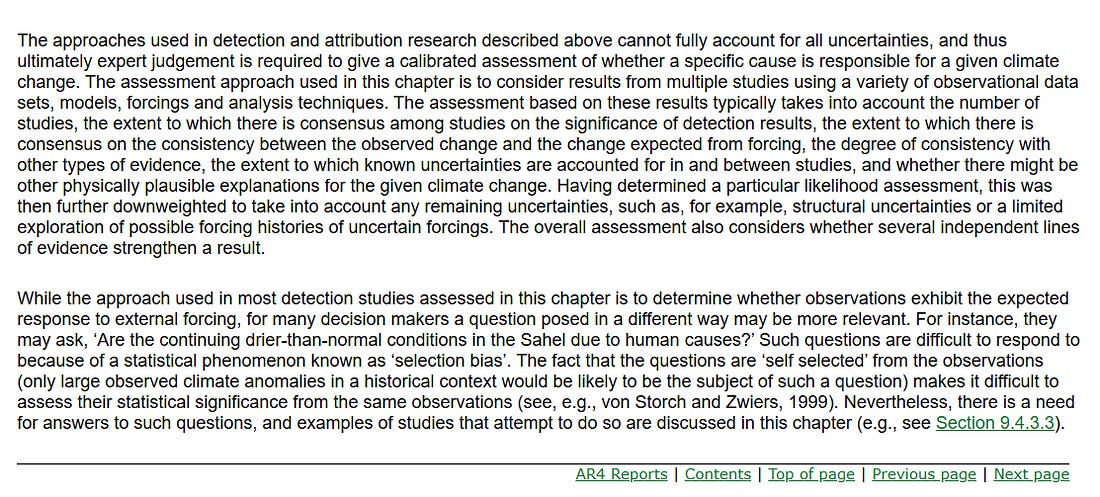
In closing, I reproduce, in full, a text box from the IPCC Fourth Assessment Report (2007) describing detection and attribution.¹
I can’t help but read this — and you should also — and conclude that we were once much smarter about these concepts.
|
|
|
I can’t imagine how many readers will make it all the way to the end of this long and nerdy post!
But if that is you, please click that “❤️ Like” button.
Appreciated!
The Honest Broker exists because of its subscribers! Join the community or upgrade your subscription with the box below.
All this new technical work is supported by THB paid subscribers
Thank you!
Comments
Post a Comment